AI Council — Agent 7 of 8
Entry & Exit Judge
Opportunity capture forensics
You can win on plan and still leak R on timing. The Entry & Exit Judge forensically grades entries, exits, and four-price excursion — so fixes are specific, not generic.
The timing specialist. Reads pre-computed entry_exit_metrics: exit quality score and plan adherence, entry timing (chasing/premature/late), exit timing and PEE sequence, opportunity cost in R, MFE/MAE capture rates, hold-time winner/loser ratio, stop/target proxy, exit tag breakdown, and pre-built timing leak summary — then grades each dimension separately.
What the Entry & Exit Judge actually outputs
Not a chat summary — a structured forensic report from your canonical trade tape, with grades, benchmarks, and prioritized recommendations.
Sample Entry & Exit Judge report
Illustrative output from a populated audit — same structure as the in-app agent renderer.
Entry & Exit Judge's Assessment
Exit quality moderate (68/100) with early exits as primary leak: 28% of trades exited early, 8.5R total left on table (~2.8R/mo). MFPE-first on 55% of sequenced trades — fear exits on breakout setup cluster in auto_exit_tags.
Benchmark analysis
What you're doing well
Good at avoiding adverse excursion relative to planned stop distance.
Majority of entries within 0.5% of planned trigger — chasing is secondary issue.
Areas needing attention
Exiting winners too early — 0.35R avg missed per early exit from MFPE analysis.
Winners capture less than half of available MFE — fear exits dominate breakout tags.
Recommended actions
Hold winners to planned target on first partial — cap early exits when MFE capture < 50%.
Expected impact: Recovers estimated 2.8R/month based on pre-computed opportunity_cost block.
Review fear-exit tagged breakout trades — 11/18 losers exited within 5 min of entry.
Expected impact: Stops premature loss-cutting pattern inflating loser count on valid setups.
What it reads from your tape
The Entry & Exit Judge receives pre-aggregated metrics from your completed trades — not a generic chat summary. Every input comes from your canonical trade tape.
- →Exit quality score, plan executed %, and early exit rate
- →Entry timing: chasing, premature, late, and optimal entry %
- →PEE analysis — MFPE-first vs MAPE-first, avg post-exit R
- →MFE capture and MAE avoidance on completed trades
- →Hold time winners vs losers, stop/target tightness proxy
What it detects
- Fear exits and early-exit tag clusters (auto_exit_tags)
- MFPE-first dominance — exiting before available upside
- Low MFE capture on winners — leaving R on the table
- Chasing entries and premature/late entry patterns
- Winner/loser hold-time imbalance (cutting winners, holding losers)
What it delivers
- Entry/exit assessment with overall score and biggest issue
- Entry timing, exit timing, and PEE deep analysis blocks
- Opportunity cost in R with estimated monthly leak
- MFE/MAE capture, hold time, stop/target proxy, exit rules
See how much R your timing leaves on the table — before it becomes your baseline
Run the Entry & Exit Judge on your completed trades. Inspect the full AI Council free on a populated demo account — read-only, no credit card.
Example finding
“28% early exits, MFPE-first 55% — avg 0.35R left per early exit; 11/18 losers tagged fear exit within 5 min on breakout setup.”
How it fits the Council
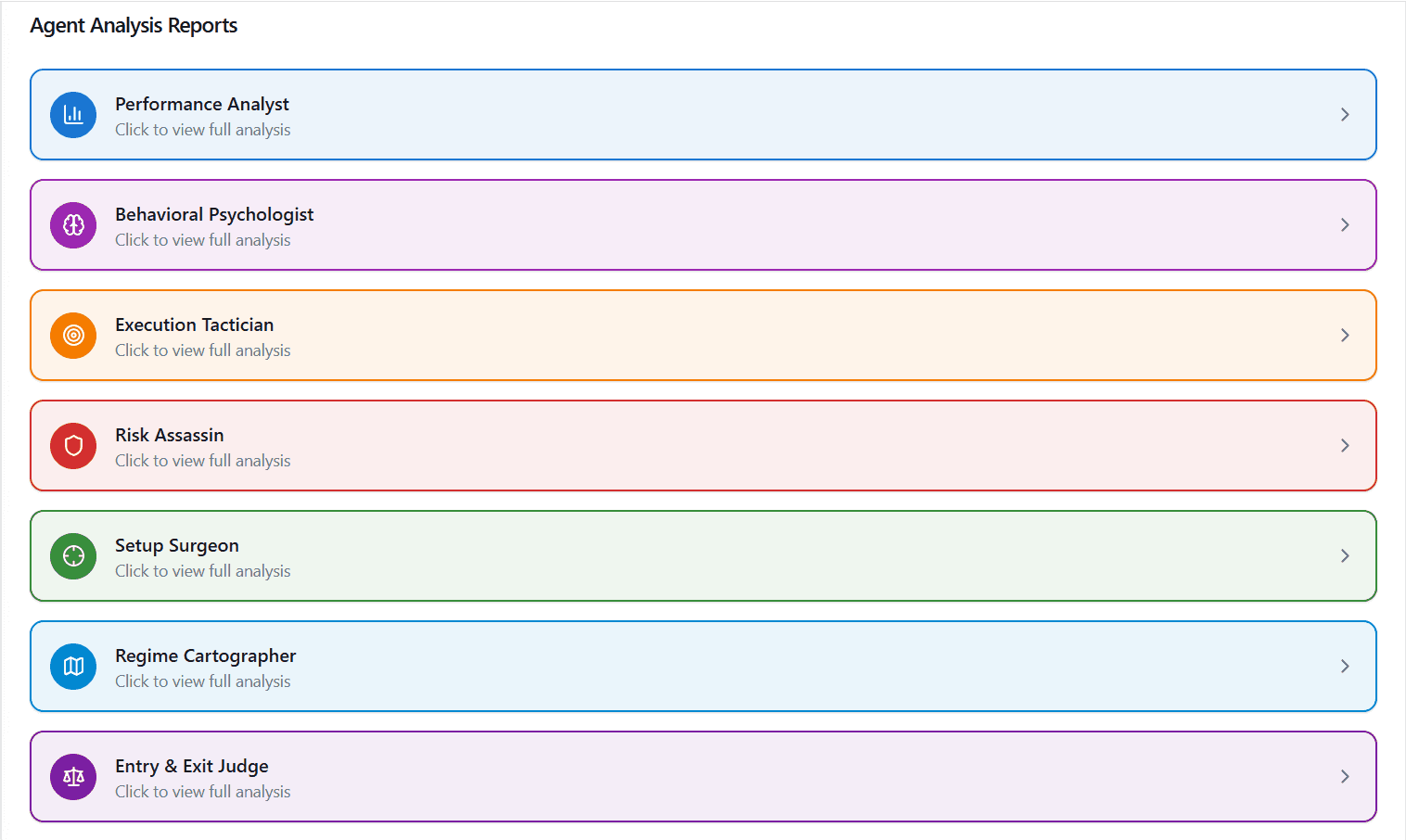
The Entry & Exit Judge runs in parallel with six other specialists on the same audit period. Each agent sees metrics tuned to its domain. When specialists disagree, they debate transparently in The Situation Room before the Chief Coaching Officer synthesizes everything into a dollar-ranked Kill List.
- 1Seven specialists analyze pre-computed metrics in parallel
- 2Disagreements surface in The Situation Room debate transcript
- 3Chief Coaching Officer ranks preventable leakage into your Kill List ($/month)
Meet the other agents
Performance Analyst
Profitability & statistical edge
Meet Performance Analyst Agent 2Behavioral Psychologist
Discipline & emotional leakage
Meet Behavioral Psychologist Agent 3Execution Tactician
Timing & fill quality
Meet Execution Tactician Agent 4Risk Assassin
Capital preservation
Meet Risk Assassin Agent 5Setup Surgeon
Setup edge & decay
Meet Setup Surgeon Agent 6Regime Cartographer
Market environment fit
Meet Regime Cartographer Agent 8Chief Coaching Officer
Synthesis & prioritization
Meet Chief Coaching OfficerFrequently asked questions
Frequently asked questions
How is this different from the Execution Tactician?
The Execution Tactician grades fill quality, behavioral vs execution slippage, session timing, and partial discipline. The Entry & Exit Judge focuses on timing decisions — chasing entries, fear exits, MFE capture, PEE (MFPE/MAPE), hold time, and stop/target placement vs plan.
What are four-price forensics?
MAE (max adverse excursion), MFE (max favorable excursion), MAPE, and MFPE — the four price extremes during and after a trade. Together they reveal whether exits were fear-driven, target-driven, or optimal given what the market offered.
What is PEE sequence?
Post-exit excursion sequence: mfpe_first means price moved favorably after you exited (missed upside); mape_first means price moved against you after exit (good exit timing). pee_analysis pre-computes counts, percentages, and avg R for each.
What data improves the analysis?
exit_quality_score and auto_exit_tags improve exit grading. mfe_price/mae_price enable capture analysis. mfpe_price/mape_price and pee_sequence power PEE blocks. planned_entry_price vs actual_entry_price improves chasing detection. entry_time + exit_time enable hold-time analysis.
How is monthly R leak estimated?
opportunity_cost.total_r_left_on_table sums R missed on early-exit trades in the audit window. estimated_monthly_r_leak divides by 12 as a simple monthly proxy — the agent cites this rather than inventing dollar figures without balance context.
See Entry & Exit Judge on your trade history
Inspect the full AI Council on a populated account — every agent visible, read-only, no credit card.